
Home › Guide
The Lucky 97 app brings together a wide spread of card, board and instant-win games inside one lobby, from classic Teen Patti tables to fast prediction rounds, spinning-reel slots and rising-multiplier crash games. For a newcomer, that variety can feel overwhelming: every game has its own rhythm, its own vocabulary and its own risk profile, and jumping in without understanding the basics is the single biggest reason beginners lose their bankroll faster than they expected. This guide walks through every major game category available in the lucky 97 lobby in plain language, explains the lucky 97 real money game mechanics behind Teen Patti hand rankings, Andar Bahar, Dragon vs Tiger, 7 Up 7 Down, Jhandi Munda and colour prediction, and then covers the practical side of playing smart: bankroll management, daily rewards, the spin wheel, VIP-style loyalty concepts, referral strategy and the mistakes that trip up most first-time players. Whether you already have the lucky97 APK installed or you are still deciding whether to register, treat this page as the reference guide you come back to before every session.
Understanding the Lucky 97 Lobby
Before diving into individual games, it helps to understand how the lobby is organised. Lucky 97's game selection typically groups titles into a few broad families: traditional card games such as Teen Patti / 3 Patti, Andar Bahar and Dragon vs Tiger; dice and board-style games such as Jhandi Munda; number and colour prediction games such as 7 Up 7 Down and colour prediction wheels; video slots with themed reels like Fortune Gems, Gates of Olympus and Starlight Princess; and instant multiplier games such as Rocket-style crash games. Each category rewards a different kind of thinking. Card games reward reading opponents and understanding probability. Prediction games reward discipline and pattern awareness (while remaining fundamentally chance-based). Slots reward patience and an understanding of variance and RTP. Crash games reward quick decision-making and a firm exit strategy. Recognising which category a game belongs to is the first step toward playing it sensibly.
Card Games
Teen Patti, 3 Patti, Andar Bahar, Dragon vs Tiger — skill-influenced betting on card comparisons.
Prediction Games
7 Up 7 Down, colour prediction — fast, simple, pure chance rounds.
Board & Dice
Jhandi Munda — a classic six-symbol dice game with quick payouts.
Slots & Crash
Themed reel slots plus Rocket-style rising multiplier games.
Teen Patti and 3 Patti Rules
Teen Patti — also written as 3 Patti, and often called "Indian poker" — is the centrepiece card game inside lucky 97 poker tables. It is played with a standard 52-card deck (no jokers) and, depending on the table, three to six players compete against each other rather than against the house. Every player is dealt exactly three cards face down. Before the deal, players contribute a compulsory "boot" amount to the pot to keep the game moving. Betting then proceeds clockwise around the table, and each player must decide whether to play blind (without looking at their cards) or play seen (after looking at their cards).
The betting round continues until only one player remains, or until the remaining players agree to a "show" — a private card comparison between the last two active players. The player holding the better hand under the Teen Patti hand rankings above wins the entire pot. Because the ranking of a three-card hand is different from five-card poker, it is worth memorising the order below before sitting at a lucky 97 poker table for real stakes.
| Rank | Hand | Description |
|---|---|---|
| 1 (Highest) | Trail / Trio | Three cards of the same rank, e.g. three Kings. |
| 2 | Pure Sequence | Three consecutive cards of the same suit, e.g. 4-5-6 of hearts. |
| 3 | Sequence / Run | Three consecutive cards of mixed suits, e.g. 7-8-9 across suits. |
| 4 | Colour / Flush | Three cards of the same suit, not in sequence. |
| 5 | Pair | Two cards of the same rank plus one unrelated card. |
| 6 (Lowest) | High Card | No pair, sequence or matching suit; highest single card decides. |
Blind vs Seen Play
Choosing between blind and seen play is the core strategic decision in every Teen Patti hand. A blind player keeps their cards face down and stakes only the current blind amount, which is typically half of what a seen player must wager. This lower cost lets a blind player stay in more hands cheaply, and because opponents cannot tell whether a confident blind bet hides a strong trail or a weak high card, blind play is a natural bluffing tool. A seen player, by contrast, looks at their three cards before betting, gaining valuable information but at double the stake. Seen players can also "pack" (fold) once their hand looks weak, avoiding further losses, whereas a losing blind player who never looks at their cards can end up contributing to a pot they were always going to lose.
A balanced approach mixes both styles: play blind occasionally with a small stake to represent strength cheaply, and switch to seen play once the pot grows large enough that the information is worth paying for. Watching how quickly opponents call, raise or pack blind can also reveal patterns worth exploiting over a longer session.
Andar Bahar
Andar Bahar is one of the simplest games in the lucky 97 online earning game catalogue, which is exactly why it moves so fast. A single card, the joker, is drawn and placed in the centre of the table. Two betting positions then open: Andar (inside) and Bahar (outside). Cards are dealt one at a time, alternating between the Andar and Bahar piles, and the round ends the instant a dealt card matches the joker's rank — whichever side that matching card lands on is the winning side. Before dealing begins, players place their bets on Andar or Bahar, so the entire skill of the game (such as it is) comes down to understanding that the first position dealt to has a very slightly different probability profile than the second, and that rounds are independent of one another — there is no dependable pattern across successive joker cards.
Dragon vs Tiger
Dragon vs Tiger strips card comparison down to its simplest form. One card is dealt to the "Dragon" spot and one card to the "Tiger" spot; whichever card ranks higher wins, with a small side bet available on a tie. There is no hand-building, no multi-round betting and no bluffing — it is a single comparison per round, which makes it one of the fastest and most transparent games in the lobby. Because outcomes are essentially a coin-flip between two cards (with a slim probability reserved for the tie), Dragon vs Tiger works best as a change of pace between longer Teen Patti sessions rather than as a primary bankroll strategy.
7 Up 7 Down
7 Up 7 Down uses a pair of dice, and players bet on whether the total of the two dice will land above 7 ("Up"), below 7 ("Down"), or exactly on 7. It borrows its structure from classic dice-based table games and is easy to learn within a single round: the payout for correctly picking Up or Down is generally lower than picking the exact number 7, reflecting that the middle outcome is rarer. Because each roll is independent, tracking a "streak" of Up or Down results across previous rounds does not change the odds of the next roll — it is a common beginner mistake to bet against or with a perceived streak as though dice have memory.
Jhandi Munda
Jhandi Munda is a traditional six-symbol dice game (sometimes using symbols like a flag, crown, spade, heart, club and diamond in place of numbers) played with six dice at once. Players place bets on one or more of the six symbols before all six dice are rolled together. Payouts scale with how many dice land on the symbol a player backed — matching more dice on your chosen symbol multiplies your return. Because six dice are rolled simultaneously rather than one at a time, Jhandi Munda tends to produce quicker, punchier rounds than sequential dice games, and spreading a small stake across two or three symbols is a common way players manage variance in a single roll.
Colour Prediction Games
Colour prediction games ask players to guess which colour (commonly red, green or violet) a timed round will land on, with a countdown clock building anticipation before each result. These games are entirely chance-based; there is no card, dice or reel mechanic to study, only a repeating countdown-and-reveal cycle. Because the format is simple and rounds are short, colour prediction is popular with beginners looking for the lucky 97 color prediction experience, but that same simplicity means it is easy to place many rapid bets in a short period. Setting a strict per-session limit before starting is especially important here, since the fast pace can accelerate losses (or wins) much quicker than a slower card game.
Slots and RTP Basics
The lucky PKR slots section of the lobby includes themed titles such as Fortune Gems, Gates of Olympus, Starlight Princess, Thunder Fire and Zoo Roulette. Slots differ from table games because there is no opponent and no hand to read — instead, each spin is generated independently, and a slot's long-run behaviour is summarised by its RTP, or return to player percentage. RTP describes the theoretical share of all money wagered on a slot that is designed to be returned to players collectively over an extremely large number of spins; it says nothing about what will happen in your next ten spins, or even your next hundred. A second concept worth understanding is volatility (sometimes called variance): a low-volatility slot pays smaller wins more often, while a high-volatility slot pays rarely but can deliver larger multipliers when it does. Choosing a slot's volatility to match your bankroll and patience is often more useful day-to-day than chasing a specific RTP number.
Crash and Rocket-Style Games
Rocket-style crash games display a multiplier that climbs steadily from 1x upward, and players must choose to cash out before the round "crashes" back to zero. The appeal is obvious — the longer you wait, the higher the potential multiplier — but the risk grows in exactly the same direction, since a crash can happen at any moment, including immediately after the round starts. Experienced players typically pick a target cash-out multiplier in advance (for example, always cashing out at 1.5x or 2x) rather than deciding in the heat of the moment, and treat any round beyond their target as a bonus rather than an expectation. Because crash games can be played extremely quickly, back-to-back rounds, they are one of the easiest places to lose track of total spending — pacing yourself here matters as much as any other game in the lobby.
Bankroll Management
No strategy guide for card games, prediction games or slots is complete without a plan for the money itself. Bankroll management is simply the discipline of deciding, before you start playing, how much you are willing to spend and how you will divide that amount across a session.
- Set a total session budget you can genuinely afford to lose, and treat it as an entertainment cost rather than an investment.
- Split that budget into small units — for example twenty to fifty equal stakes — so a single bad run does not end your session in a handful of rounds.
- Decide on a win target as well as a loss limit. Stopping after reaching either one prevents both greed and chasing losses from taking over.
- Avoid increasing your stake size specifically to "win back" a loss; this is how a small, manageable loss turns into a large one.
- Track your deposits and withdrawals over time so you have an honest picture of your overall results, not just a memory of the big wins.
Daily Check-In and the Spin Wheel
The activity or promotions section of lucky 97 typically features a daily check-in bulletin and a lucky spin wheel that players can access for a free chance at extra credit. These lucky 97 daily rewards are designed to reward consistent logins rather than heavy spending, so it is worth building a habit of checking the activity bulletin each day even on sessions where you do not plan to play a full round, simply to collect any free spins or login bonuses on offer.

Activity Bulletin
Daily and event-based promotions appear here, including double-betting reward periods.

Lucky Spin Wheel
A free spin wheel feature that can award bonus credit as part of daily engagement.
VIP and Rebate Concepts
Many apps in this category, including lucky 97, use loyalty tiers and rebate concepts to reward regular players. A VIP-style tier system generally increases in level as a player's overall activity grows, and higher tiers can unlock additional perks within the promotions section. A rebate is typically a small percentage of your wagered turnover returned to your account regardless of whether individual rounds were won or lost, which is different from a straightforward win bonus. Understanding this distinction matters: a rebate rewards volume of play, not success, so it should never be treated as a reason to increase your stakes beyond your planned bankroll — chasing rebate percentages by overspending defeats the purpose of the reward.
Referral Strategy
The invite or "Promote" panel inside lucky 97 gives every registered player a personal referral link or lucky 97 invite code that can be shared with friends. When someone registers using your link and begins playing, referral-related rewards can appear in your invite dashboard. A sensible referral strategy focuses on sharing with people who are genuinely interested in these types of games rather than mass-sharing to strangers, since engaged referrals are far more likely to actually register and play, which is usually the condition for any invite reward to unlock. Keep your referral link and any codes private to your own network rather than posting them publicly, both for your own tracking accuracy and to avoid spam-related account issues.
Promote Panel
Generate and share your personal referral link from this screen.

Invite Rewards
Track referral progress and any rewards linked to your invite code.
Common Beginner Mistakes
Playing Without a Budget
Sitting down without a fixed limit is the fastest way to overspend across a long session.
Chasing Losses
Raising stakes to recover a loss usually turns a small setback into a much larger one.
Ignoring Hand Rankings
Misjudging a Teen Patti hand's strength leads to costly calls at the show.
Betting on Streaks
Dice, cards and reels do not have memory; each round is independent of the last.
Skipping Free Rewards
Forgetting the daily check-in and spin wheel leaves free credit unclaimed.
Mixing Up Currency Units
Confusing bet units, especially on Jhandi Munda's multi-symbol boards, can inflate an intended stake.
Screenshot Gallery

Game Lobby

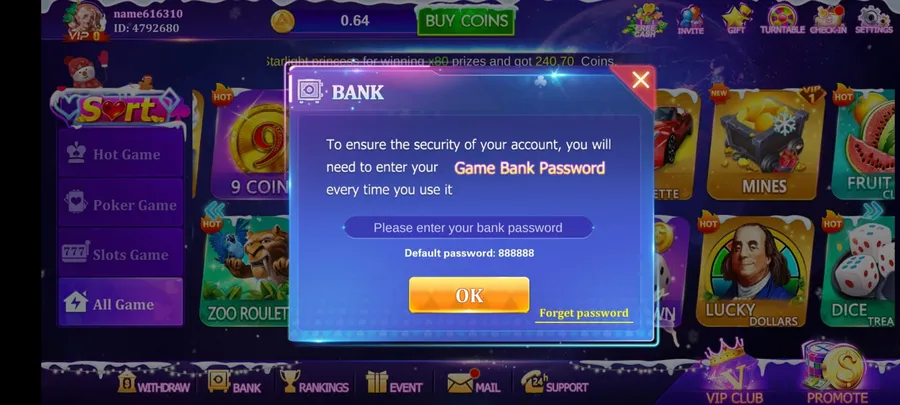
Bank Security Screen

First Deposit Promotion
Glossary of Key Terms
| Term | Meaning |
|---|---|
| Boot | The compulsory minimum contribution every player makes to start a Teen Patti pot. |
| Blind | Betting without looking at your cards, at a lower stake than a seen bet. |
| Seen | Looking at your cards before betting; requires at least double the blind stake. |
| Show | A private comparison of hands between the last two remaining players. |
| Trail / Trio | Three cards of matching rank; the highest possible Teen Patti hand. |
| RTP | Return to player — the long-run theoretical payback percentage of a slot. |
| Volatility | How often and how large a slot's wins tend to be relative to its RTP. |
| Cash Out | Locking in a crash game's current multiplier before the round ends. |
| Rebate | A small percentage of wagered turnover returned regardless of win or loss. |
| Joker Card | The centre reference card in Andar Bahar that determines the winning side. |
Frequently Asked Questions
What is Lucky 97 and how does it work?
Lucky 97 is a mobile entertainment app that bundles card games such as Teen Patti and 3 Patti, board-style games like Jhandi Munda, prediction games such as colour prediction and 7 Up 7 Down, along with slots and crash-style games in one lobby, with local payment options like JazzCash and EasyPaisa for deposits and withdrawals.
Is Teen Patti and 3 Patti the same game on Lucky 97?
Yes, Teen Patti and 3 Patti refer to the same three-card game. Teen Patti is the Hindi/Urdu name meaning three cards, while 3 Patti is simply the numeral form used interchangeably across South Asian gaming apps including Lucky 97.
What is the difference between blind and seen play in Teen Patti?
A blind player bets without looking at their cards and pays a smaller stake, while a seen player looks at their cards first and must bet at least double the current blind stake. Playing blind can be a useful bluffing strategy since it forces opponents to guess whether you have a strong hand.
What is the highest hand in Teen Patti hand rankings?
The trail or trio, three cards of the same rank, is the highest hand in standard Teen Patti hand rankings, followed by a pure sequence, sequence, colour, pair, and finally a high card hand.
How does Andar Bahar work in Lucky 97?
In Andar Bahar a single joker card is placed in the middle and cards are then dealt alternately to the Andar (inside) and Bahar (outside) side until a card matching the joker's rank appears; players bet in advance on which side that matching card will land.
What is Dragon vs Tiger and how do you play it?
Dragon vs Tiger is a simplified card comparison game where one card is dealt to the Dragon position and one to the Tiger position; you simply bet on which side gets the higher card, or on a tie, making it one of the fastest rounds in the Lucky 97 lobby.
What does RTP mean for Lucky 97 slots?
RTP, or return to player, is a theoretical long-run percentage that describes how much of all wagers a slot design is built to return to players over a very large number of spins; it is a statistical average, not a guarantee for any single session.
How risky are crash and Rocket-style games?
Crash and Rocket-style games use a rising multiplier that can end at any moment, so they are inherently high-variance; deciding on a target cash-out point before the round starts and sticking to it is the main way players manage this risk.
What is the Lucky 97 daily check-in and spin wheel?
The daily check-in is a bulletin-style feature that can reward consistent logins, while the spin wheel is a bonus wheel players can access for a free chance at extra credit; both are activity-based features found in the promotions or activity section of the app.
How does the Lucky 97 referral and invite system work?
Lucky 97 offers an invite or referral panel where you receive a personal share link or code; sharing that link with friends and having them register and play can unlock referral-related rewards displayed in the promote or invite section of the app.
What is a good bankroll management strategy for Lucky 97?
A sensible approach is to set a fixed session budget you can afford to lose, split it into small units for individual bets, avoid chasing losses by increasing stakes after a losing streak, and stop playing once you hit either your loss limit or a predefined win target.
Is Lucky 97 suitable for beginners?
Beginners can start with lower-variance, easier-to-understand games like colour prediction or 7 Up 7 Down before moving to skill-influenced games like Teen Patti, and should always review the rules, hand rankings and responsible gaming guidance first.
Where to Go Next
Once you understand the rules covered in this guide, the next practical steps are getting the app installed and your account ready. Head to the registration page to create an account, check the deposit guide for JazzCash and EasyPaisa funding steps, review the withdrawal guide before your first cash-out, and see the install walkthrough if you haven't set up the lucky97 APK yet. For device-specific downloads, the download for PC and download for iOS pages cover platform-specific steps in detail.